 OnCricketBetting
Understanding Cricket Betting Odds Formats
 Available in US
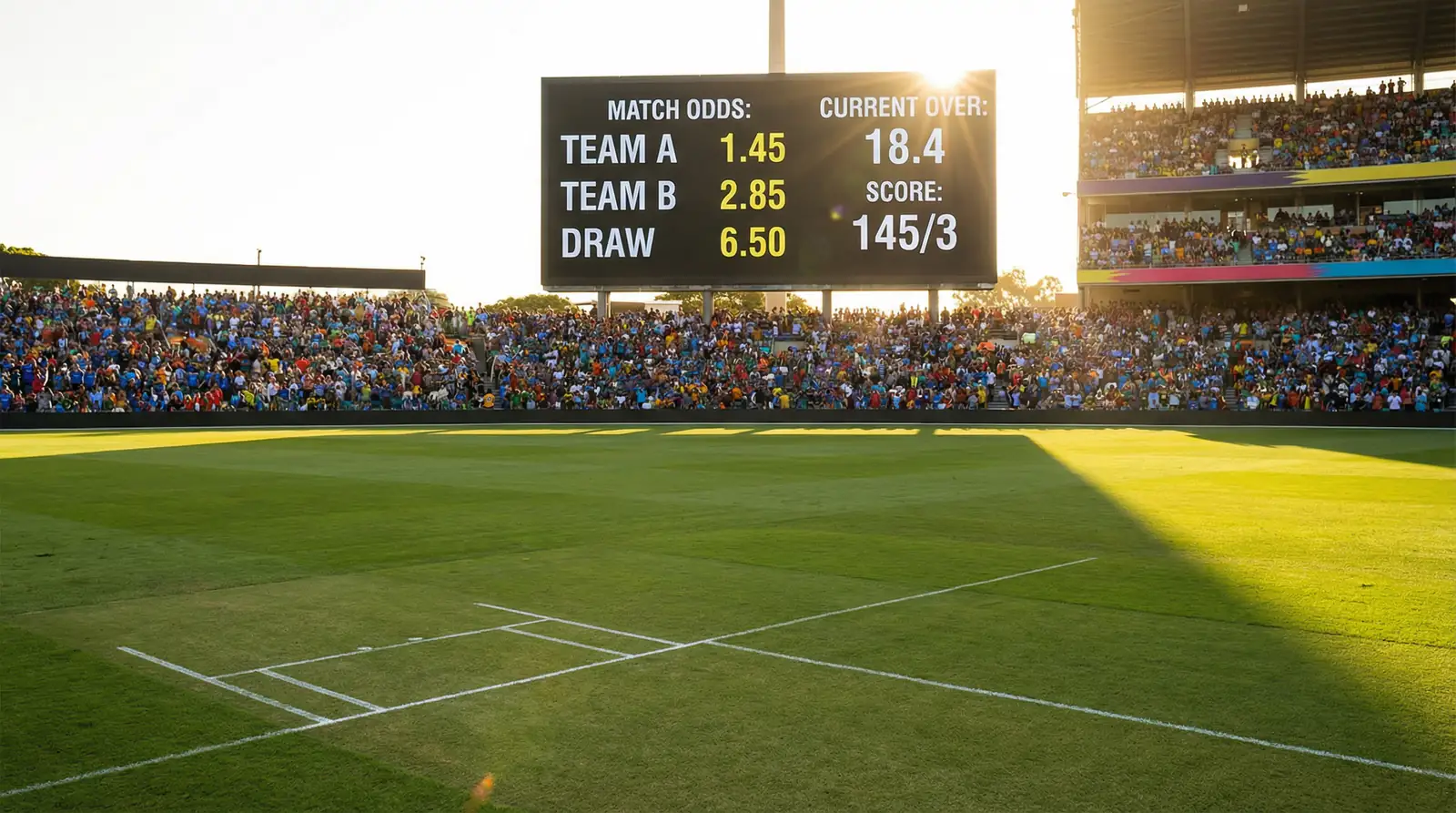
Cricket betting odds are not just numbers on a screen. They are compressed probability statements, market sentiment indicators, and the mechanism through which bookmakers communicate how likely they believe an outcome to be. If you cannot read odds fluently, you are essentially placing bets with your eyes closed. That might work at a carnival, but it is a poor strategy when real money is involved.
This guide breaks down all three major odds formats used in cricket betting, shows you how to convert between them, and explains why understanding implied probability is the single most important skill a cricket bettor can develop.
Global Odds Formats & Calculation Methods
The global betting market never agreed on a single format for displaying odds. Instead, three systems evolved in different regions, each with its own logic and quirks. Decimal odds dominate in Australia, Europe, and most online platforms. Fractional odds remain the standard in the United Kingdom and Ireland. American odds, also known as moneyline odds, are the default in the United States.
Every cricket match you find on a modern sportsbook will display odds in at least one of these formats, and most platforms let you toggle between all three. The underlying math is identical regardless of format. A 2.50 decimal price, a 6/4 fractional price, and a +150 American price all describe the same probability and the same potential return. The only difference is presentation.
Understanding all three matters because odds comparison sites, tipsters, and analysts may use any format. If someone on a cricket forum says India are "6/4 to win the first Test," you need to know instantly what that means in terms of your potential return and the implied likelihood. Fumbling with a calculator while the market moves is not a winning approach.
Decimal Odds: The Global Standard
Decimal odds are the most intuitive format, which is why they have become the default on nearly every international sportsbook. The number you see represents your total return per unit staked, including your original stake. If Australia are priced at 1.80 to win an ODI, a 100-unit bet returns 180 units total, meaning 80 units of profit plus your 100-unit stake back.
The calculation is straightforward: multiply your stake by the decimal odds. A 50-unit wager at odds of 3.20 returns 160 units. Your profit is 110 units. There is no ambiguity, no need to work out fractions, and no confusion about whether the stake is included in the return. This simplicity is exactly why decimal odds have become the industry standard for online cricket betting.
Decimal odds also make it easy to compare prices across different matches and markets. If you are looking at three different top batsman options priced at 4.50, 3.10, and 7.00, you can immediately see which offers the biggest return. Try doing that with fractional odds like 7/2, 21/10, and 6/1, and the comparison becomes far less intuitive. For anyone serious about cricket betting, getting comfortable with decimal odds should be the first step.
Fractional Odds: The British Legacy
Fractional odds tell you the profit you stand to make relative to your stake. If England are 5/2 to win the Ashes, that means for every 2 units you stake, you receive 5 units in profit. Your total return would be 7 units — the 5 units of profit plus your 2-unit stake. The numerator is always profit, and the denominator is always the stake required to earn that profit.
The format has deep roots in British horse racing and has carried over into cricket betting markets offered by UK-based bookmakers. Odds-on favourites are expressed with a larger denominator than numerator, so a team priced at 4/9 means you need to stake 9 units to win 4 units of profit. This is where fractional odds start to feel clunky. Calculating exact returns on a 37-unit stake at 11/8 is not something most people can do quickly in their heads.
Despite the inconvenience, fractional odds remain widely used in cricket betting content produced in the UK. Newspaper tipsters, broadcast commentators, and some traditional bookmakers still default to fractions. If you follow English cricket media at all, you will encounter them regularly. The key is knowing how to convert: divide the numerator by the denominator and add 1 to get the decimal equivalent. So 5/2 becomes (5 / 2) + 1 = 3.50 in decimal.
American Odds: The Moneyline System
American odds use a baseline of 100 units and split into two categories: positive and negative. Positive odds like +200 tell you how much profit you earn on a 100-unit stake. So +200 means a 100-unit bet returns 300 units total (200 profit plus 100 stake). Negative odds like -150 tell you how much you need to stake to win 100 units of profit. At -150, you must wager 150 units to earn 100 units of profit.
This format is less common in cricket betting circles, but it appears frequently on American sportsbooks that have expanded into cricket markets. With the growth of T20 leagues and the increasing interest from US-based bettors, you are increasingly likely to encounter moneyline odds when browsing platforms like DraftKings or FanDuel for IPL or Big Bash markets. The format also appears in many US-oriented betting analysis tools and podcasts.
Converting American odds to decimal is simple once you know the rule. For positive odds, divide by 100 and add 1. So +250 becomes 3.50. For negative odds, divide 100 by the absolute value and add 1. So -200 becomes 1.50. If these conversions feel tedious, most sportsbooks handle the toggle for you. But knowing the math prevents mistakes when you are reading analysis that mixes formats.
Implied Probability: The Number Behind the Number
Every set of odds encodes an implied probability — the bookmaker's estimated likelihood of an outcome occurring. This is where odds stop being abstract numbers and start being something you can use strategically. If a bookmaker prices India at 1.60 to beat Sri Lanka, the implied probability is 1 divided by 1.60, which equals 0.625, or 62.5%. The bookmaker is saying there is roughly a 62.5% chance India wins.
For fractional odds, the calculation is denominator divided by (numerator plus denominator). At 5/2, the implied probability is 2 / (5 + 2) = 28.6%. For American odds, positive odds use the formula 100 / (odds + 100), and negative odds use the absolute value divided by (absolute value + 100). At +250, the implied probability is 100 / 350 = 28.6%.
Here is why this matters for cricket betting specifically. If you believe India has a 70% chance of winning but the bookmaker's implied probability is only 62.5%, you have identified a value bet. The odds are offering you a better price than the actual probability warrants. This is the foundation of profitable betting in any sport, and cricket's variable conditions — pitch, weather, toss — create frequent opportunities for the market to misprice outcomes. Recognising value requires you to form your own probability estimates, which means studying teams, conditions, and matchups in depth. But it all starts with being able to extract implied probability from whatever odds format you encounter.
The Overround: How Bookmakers Build Their Edge
If you add up the implied probabilities for all outcomes in a cricket market, you will notice the total exceeds 100%. This excess is the overround, also called the vig or juice, and it represents the bookmaker's built-in margin. A typical cricket match winner market might have implied probabilities summing to 105-108%, meaning the bookmaker takes a 5-8% edge regardless of the result.
Understanding the overround helps you evaluate which sportsbooks offer better value. A platform with a 103% overround on a T20 match is giving you significantly better prices than one running at 110%. Over hundreds of bets, that difference compounds into a meaningful impact on your bottom line. Sharp cricket bettors routinely compare overrounds across platforms before placing a wager.
The overround also varies by market type. Match winner markets in high-profile fixtures like India vs Australia tend to have tighter overrounds because of high liquidity and competition between bookmakers. Niche markets like method of next dismissal or exact runs in an over carry wider overrounds because fewer bettors participate, giving the bookmaker more room to inflate the margin.
What Odds Cannot Tell You
Odds reflect market consensus, not objective truth. A team priced at 1.40 is not guaranteed to win — that price simply reflects the weight of money and the bookmaker's risk model at that moment. Cricket is notoriously volatile. A single dropped catch, a rain delay, or a pitch that behaves unexpectedly can overturn even the strongest favourite.
The best approach to cricket betting odds is to treat them as one input among many. Combine odds analysis with your own research on conditions, team form, and head-to-head records. When your assessment diverges significantly from the market price, you have found a potential edge. When it aligns closely, there may be no value in the bet regardless of how confident you feel about the outcome.
Odds literacy is not a betting strategy in itself. It is the language you need to speak before any strategy becomes possible. Learn to read all three formats without hesitation, calculate implied probability automatically, and compare overrounds across platforms. Once these skills become second nature, you can focus on the far more interesting question: where is the market wrong?
