 OnCricketBetting
 Complete Cricket Betting Glossary & Terms
 Available in US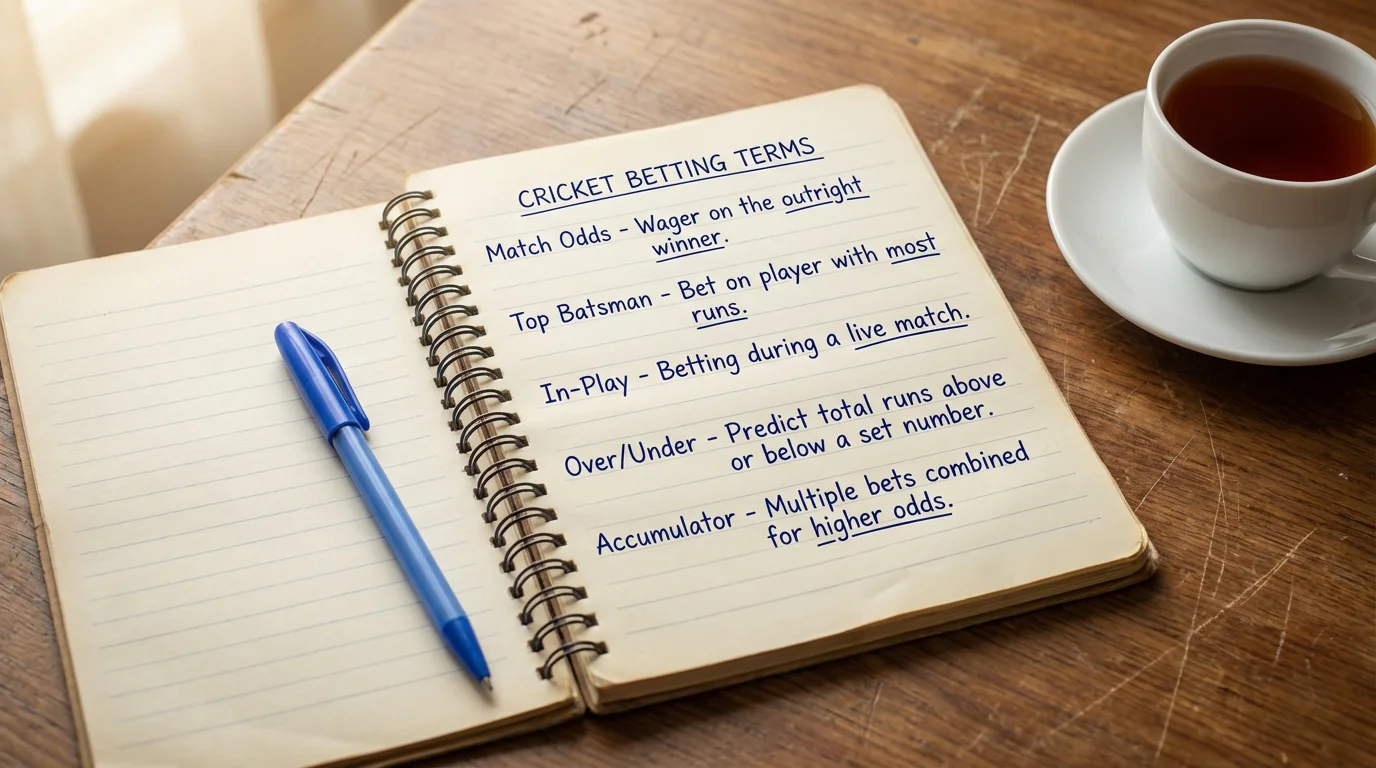
Cricket betting has its own dialect. It borrows from the sport, from the gambling industry, and from the financial markets, and the result is a vocabulary that can make a newcomer feel like they have walked into a conversation conducted in code. The problem is not that the terms are inherently complex — most of them are straightforward once explained — but that misunderstanding even one of them at the wrong moment can cost you real money. A bettor who does not understand what "dead heat" means will be genuinely confused when their winning top batsman bet pays out at half the expected amount. A bettor who does not grasp "implied probability" will never be able to assess whether odds represent value or a trap.
This is not a dictionary. Alphabetical glossaries are useful for reference but terrible for learning, because terminology only makes sense in context. Instead, this guide walks through the language of cricket betting the way you actually encounter it — scenario by scenario, from the moment you open a betting market to the moment your bet settles. By the end, you will not just know the definitions; you will understand when and why each term matters.
Opening the Market & Placing Your First Bet
Picture this: you log into your sportsbook and navigate to an upcoming T20 International between India and Australia. The screen displays a set of numbers next to each team's name, and surrounding those numbers are labels, tabs, and options that assume you already know what everything means. Here is what you are actually looking at.
The numbers next to each team are the odds — the bookmaker's expression of how likely each outcome is and how much you stand to win. In decimal odds, the most common format internationally, the number represents your total return per unit staked, including your original stake. India might be listed at 1.75 and Australia at 2.15. If you place ten dollars on India at 1.75 and they win, you receive $17.50 back — your original ten plus $7.50 profit. Australia at 2.15 would return $21.50 on the same stake.
Those odds also encode a probability estimate, which is where the concept of implied probability becomes essential. To convert decimal odds into implied probability, you divide one by the odds. India at 1.75 implies a probability of approximately 57%. Australia at 2.15 implies roughly 47%. Add those together and you get 104%, not 100%. That extra four percent is the overround — the bookmaker's built-in margin, their commission for offering the market. The overround is the reason bookmakers are profitable businesses; it ensures they collect slightly more in lost stakes than they pay out in winnings, regardless of the result. Lower overrounds mean better value for bettors, and cricket markets for major international matches typically carry overrounds between 3% and 6%.
The team with the shorter odds — India at 1.75 in this example — is the favourite, the outcome the market considers most likely. Australia at 2.15 is the underdog. These labels seem obvious, but they carry an important nuance for betting: being the favourite does not make a team a good bet, and being the underdog does not make a team a bad one. Value depends entirely on whether the odds accurately reflect the true probability, not on which side of the market a team sits.
When the Odds Start Moving
You have identified the match and noted the odds, but you do not bet immediately. Smart move. Over the next few hours, the odds will change — sometimes slightly, sometimes dramatically — as new information enters the market and money flows in on both sides.
When odds move to a longer price — say, India drifting from 1.75 to 1.85 — the market is telling you that either money is coming in on Australia, or some piece of information has weakened India's perceived chances. This movement is called drift, and it can be triggered by anything from a toss result to an injury report to a weather update. Drift is not inherently good or bad for the bettor; it is a signal that demands investigation. Why are the odds moving? If you can answer that question and you disagree with the market's reassessment, the drifted price might represent value.
The opposite movement — odds shortening from 2.15 to 1.95, for instance — is called steaming or simply shortening. This typically indicates that informed money is backing that outcome, or that positive news (a favourable toss result, a key player confirmed fit) has improved the team's prospects. Monitoring these odds movements in the 30 to 60 minutes before a match is one of the most valuable habits a cricket bettor can develop, because the movement itself contains information about what the sharpest participants in the market believe.
The concept of sharp money versus public money underpins much of this movement. Sharp money comes from professional or highly informed bettors whose action bookmakers respect enough to adjust their lines in response. Public money comes from recreational bettors whose action the bookmaker is happy to absorb. When odds move against the public favourite — when the team everyone expects to win starts drifting — it often indicates that sharp bettors are on the other side, and that is worth paying attention to.
When the Match Is Live
The match begins, and a new category of terminology comes into play — literally. In-play betting (also called live betting) allows you to place wagers while the match is in progress, with odds updating continuously based on the evolving situation. Cricket is exceptionally well-suited to in-play markets because matches unfold over hours, with constant shifts in momentum that create new betting opportunities.
In Test cricket, the concept of session betting becomes relevant. Each day of a Test is divided into three sessions — morning, afternoon, and evening — and bookmakers offer markets on the number of runs scored or wickets taken within each session. Session betting rewards the bettor who is actually watching the match and can read how the pitch is behaving, how the light is affecting play, and whether the bowlers are finding assistance. It is one of the most skill-intensive forms of cricket betting because the relevant variables are changing in real time and the bettor who processes them fastest has the clearest advantage.
During live betting, you will occasionally see a market described as suspended. This means the bookmaker has temporarily stopped accepting bets, usually because a significant event has just occurred — a wicket has fallen, a review has been called, or rain has interrupted play — and the odds need to be recalculated before the market reopens. Suspension is a routine part of in-play betting, not a cause for alarm, but it does mean that timing your live bets is important. If you wait until after a wicket falls to act on your analysis, you will find the market suspended and the new odds less favourable when it reopens.
The cash out option, offered by most major bookmakers during live play, allows you to settle your bet before the match concludes. If your pre-match bet is currently in a winning position, the cash-out offer lets you lock in a profit at a reduced rate rather than waiting for the final result. If your bet is losing, cash out lets you salvage a portion of your stake. Cash out is essentially a real-time hedge — it trades potential maximum profit for guaranteed partial return — and whether to use it depends on your assessment of how the match is likely to develop from the current position.
When You Build a Complex Bet
Not every bet is a simple match winner wager. Cricket betting offers a range of structures that combine multiple selections or add layers of complexity, and each comes with its own terminology.
An accumulator (also called a parlay in North American markets) combines multiple individual selections into a single bet. The odds of each selection multiply together to produce higher combined odds, but every selection must win for the bet to pay out. A three-leg accumulator on three match winners might offer combined odds of 6.00 or higher, which looks attractive until you recognise that the probability of all three selections winning is typically below 20%. Accumulators are popular because they offer large returns from small stakes, but the compounded bookmaker margin across multiple legs makes them structurally difficult to profit from over time.
Each way betting splits your stake into two parts: a win bet and a place bet. In cricket outright tournament markets, the win portion pays at full odds if your selection wins the tournament, while the place portion pays at reduced odds — typically one-quarter or one-fifth of the win odds — if your selection finishes in a specified number of top positions. Each way bets are most useful for longer-priced outright selections where reaching the semi-finals or final is plausible even if winning the whole event is unlikely.
A dead heat occurs when two or more players tie for a position in a market — say, two batters finish with 75 runs in a top batsman market. When this happens, your stake is divided by the number of tied players, and the payout is calculated on the reduced stake. If two players tie and you backed one of them, you receive half the normal payout. Dead heat rules are one of the most common sources of confusion for newer bettors, and understanding them before you encounter one is far preferable to discovering them on your betting slip after the fact.
When the Result Settles
The match is over, and your bet needs to be resolved. In straightforward cases — your team won, the total went over the line — settlement is instant and obvious. But cricket, with its weather interruptions, rule complexities, and multi-day formats, produces settlement scenarios that are anything but straightforward.
A bet is declared void when the conditions for settlement cannot be met. If a match is abandoned without a result due to rain, most match winner bets are voided, and your stake is returned. However, the specific rules vary between bookmakers and between markets. Some platforms void bets if fewer than a specified number of overs are bowled; others settle bets based on the result at the point of abandonment. Reading your bookmaker's settlement rules before placing a bet on a weather-threatened match is not optional — it is the difference between an unpleasant surprise and an informed decision.
The DLS method (Duckworth-Lewis-Stern) is cricket's mathematical system for recalculating targets in rain-affected limited-overs matches, and it has direct implications for bet settlement. When overs are lost to rain, DLS adjusts the chasing team's target based on the resources remaining. Your over/under bet that looked comfortable before the rain interruption may settle very differently after a DLS recalculation, because the revised total and the revised target can shift the market in ways that are not intuitively obvious. Different bookmakers handle DLS-affected matches differently — some settle based on the DLS-adjusted result, others void the bet entirely — and knowing which policy applies to your bet matters.
A push occurs when the result lands exactly on the line. If you bet on over 165.5 runs and the total is exactly 165, the under wins. But if the line was set at 165 (without the half-point), a total of exactly 165 is a push — your stake is returned with no profit or loss. Most cricket markets use half-point lines specifically to avoid pushes, but whole-number lines do appear in some markets, and knowing the push rules prevents confusion.
The Glossary You Build Yourself
Every term in this guide will make more sense after you encounter it in practice than it does on a screen right now. The first time a dead heat cuts your payout in half, you will understand that term with a clarity no definition can provide. The first time you watch odds drift from 1.80 to 2.10 in the minutes after a toss and realise you could have captured that movement, the concept of pre-match information windows will stop being abstract. Cricket betting terminology is not learned by reading — it is learned by doing, and then coming back to the definitions when the experience raises questions that need precise answers. Treat this guide as a map you will return to, not a textbook you need to memorise. The real glossary is the one you will write for yourself, one bet at a time.
