 OnCricketBetting
 Weather Impact on Cricket Betting & DLS Rules
 Available in US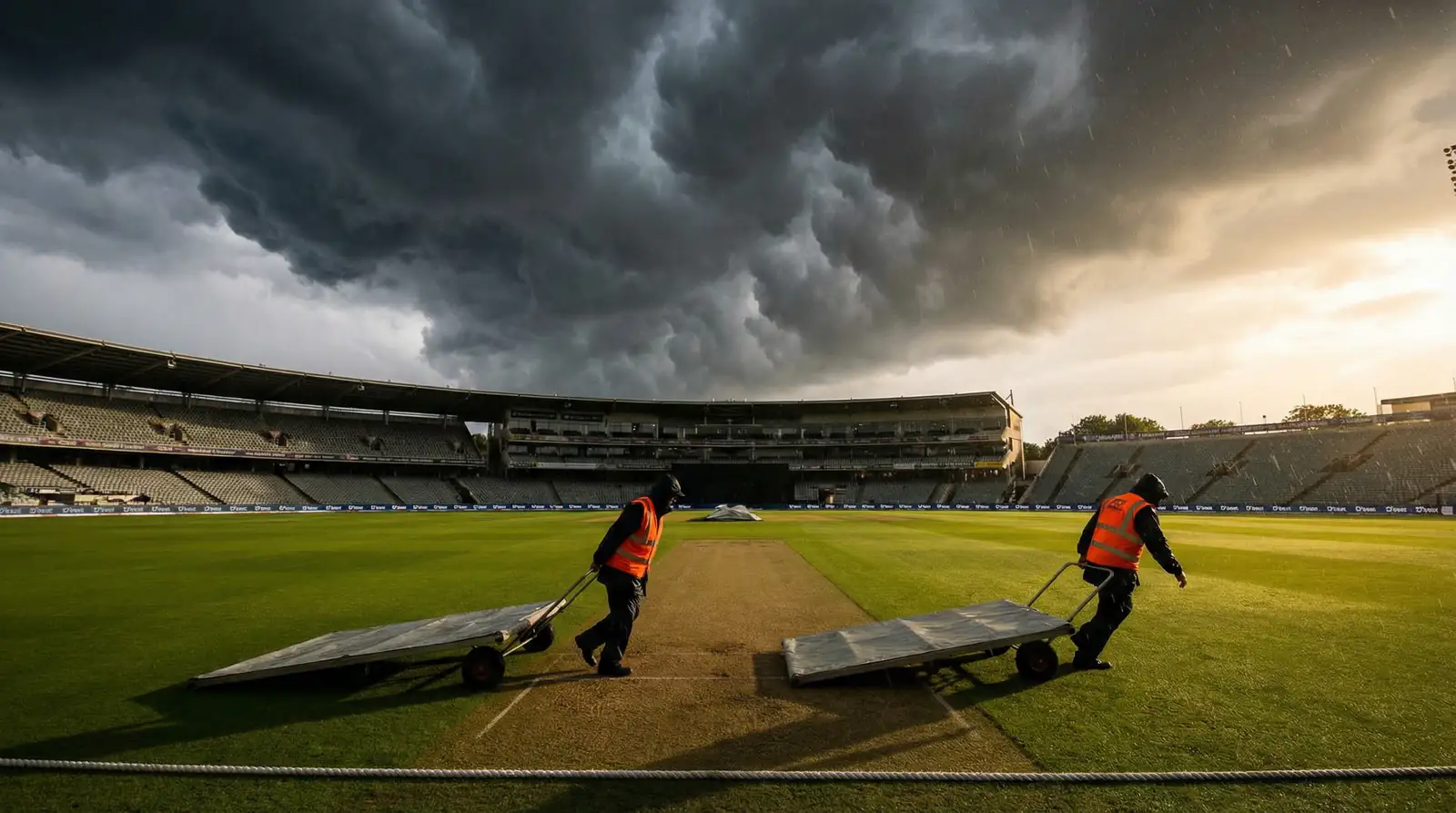
Cricket is one of the few major sports where weather does not merely inconvenience the schedule — it fundamentally alters the competition itself. A rain delay in football means everyone waits. A rain delay in cricket changes the target, rebalances the match, and creates an entirely new probability landscape. For bettors, weather is not an annoyance to be endured. It is a variable to be exploited.
Rain, overcast skies, dew, humidity, and wind all influence cricket matches in measurable ways. Some of these effects are well understood by the market. Others are priced poorly or ignored entirely. This guide explains each weather factor, its mechanical impact on match outcomes, and the specific betting strategies that weather-aware bettors can deploy.
How Rain Interruptions Shift Betting Markets
Rain is the most dramatic weather variable in cricket because it physically stops play and triggers mechanical consequences for the match format. In limited-overs cricket, a rain delay reduces the number of overs available and activates the Duckworth-Lewis-Stern method for target recalculation. In Test cricket, rain removes playing time and pushes the match toward a draw.
The immediate market impact of rain in a limited-overs match is a repricing of the match winner odds and the introduction or repricing of the no-result market. Most sportsbooks void bets if a match is abandoned or does not reach the minimum overs threshold (typically 20 overs per side in ODIs, five overs per side in T20s). This voidance risk is itself a factor — if rain is forecast, some bettors avoid the match entirely, which reduces liquidity and can cause the remaining odds to become less efficient.
The more interesting dynamic occurs when rain interrupts but does not abandon the match. A team that was cruising in a 50-over chase at 120 for 1 after 25 overs might find themselves needing 80 off 15 overs under DLS after a two-hour delay. That revised target could be either generous or harsh depending on the specifics of the DLS calculation, and the market must reprice the match accordingly. Bettors who understand DLS at a granular level can identify situations where the post-rain odds do not accurately reflect the revised contest.
Rain during the first innings of a limited-overs match creates a different set of dynamics. If the batting team's innings is shortened, the total they post will be lower, but the DLS method adjusts the chasing team's target downward as well. The critical question is whether the first-innings team had time to build properly or was caught in an awkward position when rain arrived. A team that was 180 for 3 after 35 overs and sees the innings cut to 40 overs has a different DLS profile than one that was 80 for 4 after 20 overs and gets the same reduction. The score at the point of interruption relative to the DLS par score tells you whether the interruption helped or hurt the batting team.
Overcast Conditions and Swing Bowling
Cloud cover does not stop play, but it materially changes the nature of the contest. Overcast skies in certain atmospheric conditions increase the lateral movement of the ball through the air — what cricketers call "conventional swing." The precise meteorological mechanism is debated, but the empirical evidence is overwhelming: fast bowlers generate more swing under cloud cover, particularly with the new ball and in the first 20 overs of an innings.
The venues where overcast conditions have the strongest impact are concentrated in the traditional swing bowling territories: England, New Zealand, and parts of South Africa. At grounds like Trent Bridge, Headingley, and Hagley Oval, an overcast morning session can produce dramatically bowler-friendly conditions that would be unrecognisable on a sunny afternoon at the same venue. The run rate in the first ten overs under heavy cloud cover at these grounds can be 30-40% lower than on clear days.
For betting purposes, overcast conditions create value in several markets. First-session or powerplay run totals tend to be lower when cloud cover is heavy, making the under an attractive proposition. Top bowler markets favour swing specialists, particularly those with a track record of exploiting overcast conditions. Match winner odds should shift toward the team that wins the toss and bowls first, because they get first access to the best bowling conditions.
The challenge is timing. Weather forecasts are imperfect, and cloud cover can dissipate unexpectedly. A morning that looks overcast might clear by lunch, transforming the pitch into a batting surface. The bettor who checks hourly forecasts and waits for the actual conditions to be visible before committing to a bet holds a meaningful advantage over one who acts on the morning forecast alone.
Dew: The Invisible Advantage
Dew forms on the outfield and the pitch surface during evening and night matches when the air temperature drops below the dew point. In practical terms, this means the ball becomes wet and slippery, making it harder for bowlers to grip and for fielders to hold catches cleanly. Dew overwhelmingly favours the team batting second, because they bat during the period when dew is heaviest.
The dew factor is most pronounced in the Indian subcontinent and the Middle East, where day-night and evening matches are standard for major T20 leagues. During the IPL, dew has been a persistent second-innings advantage that consistently tilts outcomes toward the chasing team. Statistical analysis across multiple IPL seasons shows that the team batting second wins at a higher rate in evening matches than in afternoon games, with dew cited as the primary differentiating factor.
For bettors, dew creates a straightforward edge when combined with toss analysis. In venues and conditions where dew is expected, the toss winner who elects to bowl gains a meaningful advantage. If the match winner odds do not shift sufficiently after the toss in a dew-prone evening game, the chasing team is likely underpriced. This is one of the more consistently exploitable inefficiencies in T20 cricket betting.
The magnitude of the dew effect varies by venue and season. Early-season IPL matches in southern India (Chennai, Bangalore) experience less dew than mid-season matches in northern cities (Delhi, Kolkata) where the temperature differential between day and night is greater. Bettors who track seasonal dew patterns at specific venues can calibrate their models more precisely than the market's one-size-fits-all approach.
Humidity, Wind, and Atmospheric Pressure
Beyond rain and cloud cover, more subtle atmospheric conditions influence cricket outcomes in ways that the market rarely prices directly. Humidity affects how the ball swings through the air — higher humidity is generally associated with greater swing movement, though the relationship is more complex than a simple correlation. Wind direction and strength influence the carry of the ball to the boundary, the drift of spin bowling, and the trajectory of lofted shots.
At coastal venues, wind can be a decisive factor. Cape Town's Newlands, Wellington's Basin Reserve, and Galle International Stadium are all subject to strong, directional winds that vary between sessions. A bowler operating with the wind behind him can generate extra pace and bounce, while a spinner bowling into a crosswind may find additional drift that makes his deliveries harder to read. For bettors, wind conditions at these venues are worth monitoring because they influence which end is more dangerous for bowling and, consequently, which bowlers are likely to take wickets.
Atmospheric pressure changes, while rarely discussed in betting circles, have a documented effect on ball behaviour. Lower atmospheric pressure (often associated with approaching weather systems) can increase the ball's swing, while higher pressure generally produces more benign conditions. This is an edge for the deeply analytical bettor who monitors barometric pressure alongside standard weather forecasts, though it is admittedly a niche advantage that applies most strongly in conditions already favourable for swing bowling.
Building a Weather-Based Betting Strategy
Integrating weather analysis into your cricket betting requires a systematic approach rather than ad hoc reactions to forecasts. The foundation is a reliable weather source — and "reliable" in this context means hourly forecasts rather than daily summaries. Knowing that it will rain "sometime on Saturday" is nearly useless. Knowing that there is a 70% chance of rain between 2pm and 4pm gives you actionable information about which session will be affected and how.
The practical steps begin several hours before the match. Check the forecast for the specific venue — not just the city, as microclimates can produce different conditions across a metropolitan area. Assess cloud cover, precipitation probability by hour, temperature trajectory (for dew estimation), and wind speed and direction. Compare these conditions to historical data for the venue to establish how the surface and the ball typically behave under similar circumstances.
The next step is identifying which betting markets are most affected by the expected conditions. Rain forecasts primarily impact the no-result market, DLS-adjusted match winner odds, and session totals. Overcast skies affect powerplay run totals, top bowler markets, and toss-dependent match winner odds. Dew primarily affects the second-innings team's match winner odds and over/under totals for the chase.
The Bettor Who Checks the Forecast
Weather analysis is not glamorous. It does not carry the intellectual appeal of statistical modelling or the tactical thrill of reading in-play momentum shifts. It is, at its core, the act of checking a forecast and thinking about what it means for a cricket match. But the simplicity of the input belies the power of the output.
Most cricket bettors do not check the weather at all, or they check it casually and fail to translate conditions into specific market expectations. This means the bar for gaining an edge is remarkably low. You do not need a meteorological degree or a proprietary weather model. You need an hourly forecast, a basic understanding of how atmospheric conditions affect cricket, and the discipline to let weather data influence your betting decisions rather than treating it as an afterthought. The sky is literally telling you how the match will play. The only question is whether you are listening.
